
A flawed equation for forests, people, and planet
A new briefer from the Global Forest Coalition GFC’s latest research critically examines the REDD+ program, showing that it has little to do with reducing deforestation while facilitating land grabbing, logging and monoculture plantations and causing rights violations.
Download the report in English - French - Spanish

The Great REDD+ Climate Illusion: A flawed equation for forests, people, and planet
Introduction

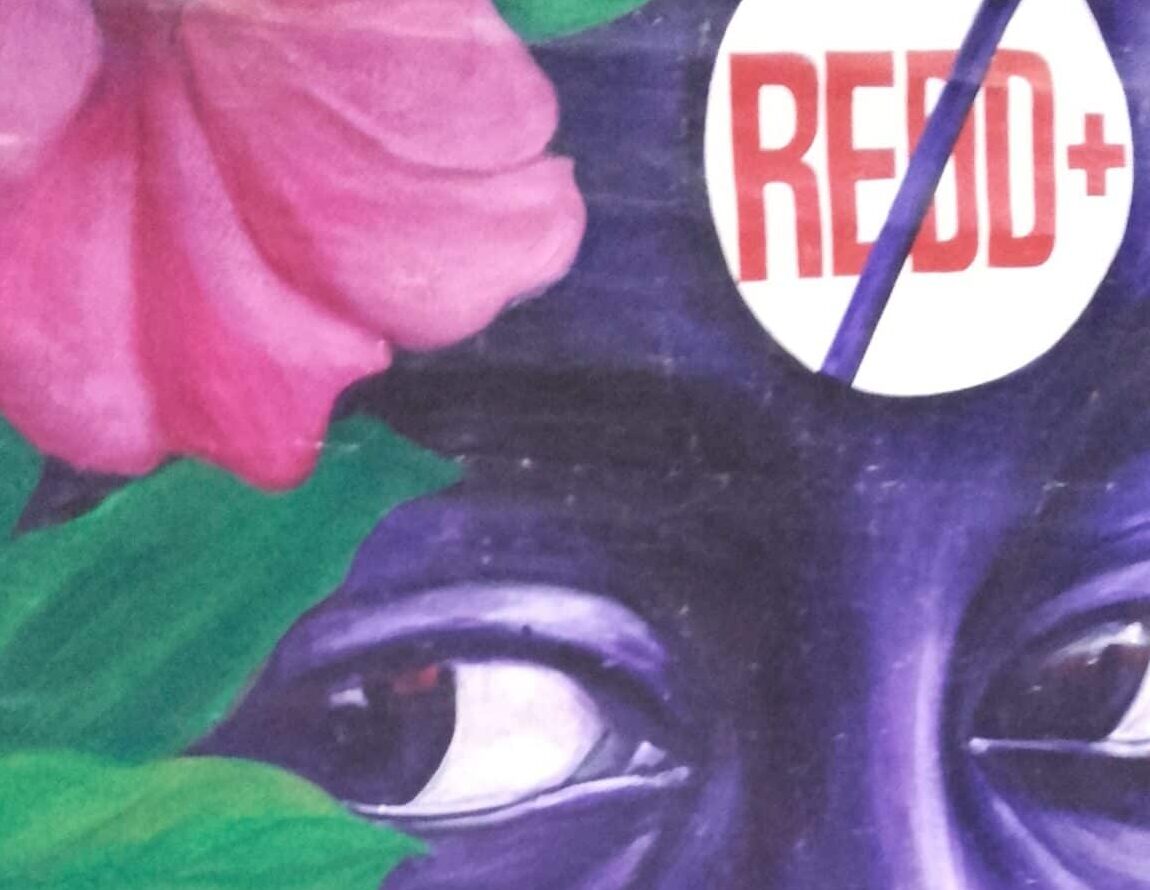
Image courtesy of NO REDD AFRICA/Cassandra
Is REDD+ reducing deforestation?
This briefer builds on the findings of GFC’s recent publication, Who Really Benefits? How REDD+ Fails Forests and Those Who Protect Them, expanding on REDD+ and the broader carbon offsetting frameworks within it. The previous briefer showed that while REDD+ was designed to combat deforestation, evidence from countries like Brazil and Indonesia shows that it has failed to achieve any significant reductions in deforestation. At the same time, biodiversity has continued to suffer. These programs, often involving monoculture tree plantations which are known to harm communities and the environment, do not work—you cannot quickly recover the years of complex interrelations that are already lost when forests are decimated. The previous briefer also highlighted how REDD+, at its core, commodifies forests by reducing their value to mere carbon sinks, overlooking their true role as complex ecosystems that regulate the planet's climate, support local communities and Indigenous Peoples, and sustain irreplaceable biodiversity. It prioritizes offsets over ecological integrity and community rights. Forests are not treated as inherently valuable as essential living ecosystems, but rather as resources that can be used and commodified into base molecules like “carbon”. This not only goes against Indigenous worldviews that consider life as inherently valuable on its own, but REDD+ also further neglects and oppresses Indigenous Peoples and local communities, leading to displacement and conflicts, loss of livelihoods, and cultural practices. Indigenous Peoples are already protecting forests, and to continuously harm them through these programs demonstrates the inherently incompatible nature of REDD+ with forests and forest peoples. The market-driven nature of REDD+ also disregards traditional knowledge and deeper understandings of forests’ ecological and spiritual roles. There is an urgent need for community-driven, rights-based strategies, including direct funding for those already doing the work. Yet, despite its demonstrated fundamental flaws, REDD+ remains a large part of the climate discourse due to ongoing support from multilateral financial institutions (like the World Bank and the Green Climate Fund), its inclusion in the negotiations of Article 6.4 of the Paris Agreement, and its role in voluntary carbon markets. This cannot continue.Who is financing REDD+?
There are over 700 REDD+ projects across 57 countries, supported by both bilateral and multilateral funding. Major players include the UN-REDD Programme and the World Bank's Forest Carbon Partnership Facility, each covering 50+ countries. Since 2008, over US$ 5.6 billion (or up to almost $10 billion) of public money has been pledged to multilateral climate funds supporting REDD+, with $3 billion approved for projects. Major contributors are Norway, Germany, the United Kingdom, and the United States. Despite these investments, deforestation continues. Issues like leakage, lack of permanence, and counting of monoculture plantations as forests have underscored REDD+'s ineffectiveness. In light of this, what roles do governments play in supporting REDD+? What are their motivations? Should funding for REDD+ projects be stopped entirely?Offsetting controversy

Demostration against REDD+ on a beach in Durban, South Africa, Photo by Souparna Lahiri, GFC.


