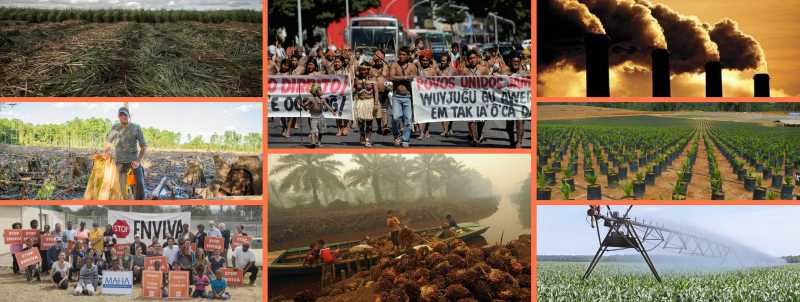
Civil society groups reject the impact of an exponential growth of the Bioeconomy
In recent years, governments have given support to substitute fossil fuels with biomass for energy, in the name of climate change. Increasingly, they are also considering support for other products made out of bio-materials, which is fashionably named the ‘bioeconomy.’
The Biofuture Platform, an initiative proposed by the Brazilian government and launched with support from 20 countries in 2016, is one example. However, a closer look at this Platform shows that the bioeconomy is simply a cover-up for a significant increase in bioenergy, together with other short lived ‘bio-products’ whose climate credentials are as bad for the climate as bioenergy. [1] The European Union and several countries (which have not so far signed up to the BioFuture Platform) are also developing ‘bioeconomy strategies’ with a similar purpose. [2]
The undersigned organisations are concerned that scaling-up the use of bioenergy and other short-lived bio-products (the so-called-bioeconomy) will have detrimental impacts on the climate, human rights, nature protection, and the transition to a low-carbon energy system. We reject the BioFuture Platform and other similar developments for the following reasons:
Bad for the climate:
To meet the Paris Agreement goal of keeping the global temperature rise below 1.5 degrees, we must swiftly phase out emissions and simultaneously increase the amount of carbon that can be removed by forests, grasslands, and soils. In direct opposition to this, the BioFuture Platform advocates transitioning the energy, transport, and industrial sectors to bioenergy and biomaterials. This ignores the science – burning biomass for energy releases as many emissions as burning coal[3], while the production and consumption of biofuels, bioplastic or other biomaterials reduces land available for crops, leads to deforestation and other land conversions, and releases nitrous oxide.
To mitigate the worst effects of climate change, we need governments, NGOs, academia, and the private sector to work together to reduce overconsumption of energy and decarbonize the energy, transport, and industrial sectors – not merely allow the rich to continue over-consuming whilst transitioning to another carbon-intensive resource.
Bad for human rights:
An industrial bioeconomy would increase demand for land to grow biomass. This would drive deforestation and other land use change on a scale that would have devastating impacts on people. A conservative study about the global biomass potential [4] found that for bioenergy to provide five per cent of global energy use, it would require the conversion of an area of land larger than India (386 million hectares). The bioeconomy foreseen by the BioFuture Platform would need even more land to be converted for bioproducts. The underlying assumption is that most the land needed to convert the fossil fuel economy to the bioeconomy would be provided by the global South. But growing demand for biofuels and biomass for heat and electricity, has already led to large-scale land grabbing and the eviction of entire villages, and reduced access to farmland, forest and water resources. [5] Expanding demand will worsen those impacts, especially where forests are replaced by plantations, increasing pesticide poisoning and labour rights violations, and reducing clean water and food sovereignty. In addition, the processing and burning of biomass for energy releases a variety of toxic emissions, posing additional health risks.
Bad for nature and biodiversity:
We are in the midst of a biodiversity crisis, which will be worsened by the BioFuture Platform’s proposals to increase demand for land, water, and forests. Demand for palm oil and soy is already accelerating forest destruction in many countries and intensification of agriculture (more chemicals, less fallow land) in Europe and North America is accelerating the decline in insects and birds. [6] Demand for bioenergy has already led to the clearcutting of highly biodiverse forests in the southern US, [7] the Baltic States [8] and elsewhere, and as monoculture plantations advance, agrobiodiversity reduces, and nature suffers. Plantations for bioplastics and other biomaterials will just make these problems worse. We need to be reducing demand for wood and crops, not increasing it. There is also an assumption that production of bioproducts will depend heavily on use of genetically engineered crops, trees, and microbes, all of which pose serious risks to the environment and human health.
Bad for a just transition from the fossil fuel economy:
The BioFuture Platform’s vision distracts attention and resources away from real, proven solutions to climate change and entrenches energy, social and economic injustices around the world. It would encourage further bioenergy subsidies at the expense of genuinely low-carbon renewable energy such as wind and solar power which must be immediately scaled up in a manner which respects community rights. “Modern bioenergy” (biofuels and biomass for heat and electricity) promoted by the BioFuture Platform is primarily used in the global North and by the energy-hungry industries who should be reducing consumption. Bioenergy gives them a get out clause from dealing with their wasteful consumption.
The undersigned groups call on the 20 countries and the multilateral organisations that are signatories to the BioFuture Platform to end support for bioenergy and other short-lived bioproducts. We call on other governments to refrain from supporting the Platform and its demands. We call instead for governments to propose meaningful and equitable responses to the climate crisis which respect human rights, focus on proven low carbon technologies, reduce overconsumption and waste, and protect forests and other ecosystems.
References:
[1]
biofutureplatform.org
[2] See
ec.europa.eu/research/bioeconomy/index.cfm?pg=policy&lib=strategy for the EU Bioeconomy Strategy review.
[3] See
biofuelwatch.org.uk/biomass-resources/resources-on-biomass/ for a list of scientific studies which show that energy from burning wood is far from carbon neutral.
[4] Biomass Energy: The Scale of the Potential Resource, Christopher B Field et al, Trends in Ecology and Evolution, February 2008; Note that the 5% figure is based on global energy use in 2005. It translates into 27 EJ
[5] According to an ActionAid report, EU investors acquired 6 million hectares of land in sub-Saharan Africa for biofuel production by May 2013, yet the EU has imported very little feedstock for agrofuels from Africa, suggesting that the hype around bioenergy alone was a major driver behind those large land-grabs, which led to the eviction of entire villages, and to many communities losing access to their farmland, forests and water resources
actionaid.org/sites/files/actionaid/adding_fuel_to_the_flame_actionaid_2013_final.pdf
[6] See for example
e360.yale.edu/features/insect_numbers_declining_why_it_matters
[7] See for example
dogwoodalliance.org/wp-content/uploads/2017/05/NRDC_2014-2017Booklet_DigitalVersion-resize.pdf
[8] See
climatechangenews.com/2018/01/16/logging-surge-threatens-quarter-estonias-forest-warn-conservationists/
Signatory civil society organisations
International:
Global Forest Coalition
Indigenous Environmental Network (IEN)
Soroptimist International
Women’s International League for Peace and Freedom
ActionAid International
Regional:
Birdlife Europe and Central Asia
Corporate Europe Observatory – EU
Fern – Europe
National:
Acción por la Biodiversida – Argentina
Amigos de la Tierra Argentina – Argentina
Kalang River Forest Alliance – Australia
Bellingen Environment Centre – Australia
Bob Brown Foundation – Australia
Kalang Progress Association – Australia
“System Change Not Climate Change” – Austria
Aliança RECOs – Redes de Cooperação Comunitária Sem Fronteiras – Brazil
Movimento Mulheres pela P@Z! – Brazil
Grupo de Trabalhos em Prevenção Posthivo (GTP) – Brazil
Oykos Capacitação – Brazil
No One Left Out (NOLO) – Cameroon
Struggle to Economize Future Environment (SEFE) – Cameroon
Ecology Action Centre – Canada
Journalists for Human Rights
Blue Dalian – China
China Environmental Paper Network – China
Green Longjiang – China
Scholartree Alliance – China
Snow Alliance – China
Wuhu Ecology Center – China
COECOCEIBA – Amigos de la Tierra Costa Rica – Costa Rica
Red de Coordinación en Biodiversidad – Costa Rica
Czech Coalition for Rivers – Czech Republic
Forests of the World – Denmark
NOAH – Friends of the Earth Denmark
EcoHaina – Dominican Republic
CESTA – Friends of the Earth El Salvador
Estonian Forest Aid (Eesti Metsa Abiks)
New Wind Association – Finland
Finnish Association for Nature Conservation – Finland
Ilmastovanhemmat (Climate Parents) – Finland
Kepa – The Finnish NGO Platform
Luonto-Liitto – Finnish Nature League
Canopée – France
Les Amis de la Terre – France
Worldview – the Gambia
Arbeitsreis Regenwald und Artenschutz (ARA) – Germany
BUND Kandertal – Germany
Rettet den Regenwald e.V. – Germany
Seeds Action Network – Germany
denkhausbremen – Germany
The Development Institute – Ghana
Abibiman Foundation – Ghana
Plataforma Internacional contra la Impunidad – Guatemala
All India Forum of Forest Movements – India
Centre for Environment Education Himalaya – India
Indigenous Perspectives – India
JIKALAHARI – Indonesia
Kaliptra Andalas – Indonesia
KKI WARSI – Indonesia
Link-AR Borneo – Indonesia
WALHI-Friends of the Earth Indonesia
Yayasan Citra Mandiri Mentawai – Indonesia
Cevi de Udine – Italy
Solidarietà e Cooperazione/CIPSI -Italy
SONIA/“Society for New Initiatives and Activities” for a Just New World – Italy
Coordinadora de Pueblos y Organizaciones del Oriente del Estado de México en Defensa de la Tierra, el Agua y su Cultura – Mexico
Frente Amplio No Partidista en contra del Nuevo Aeropuerto y otros Megaproyectos en la Cuenca del Valle de México – Mexico
Grupo Mesófilo A.C. – Mexico
Forest Observatory – Morocco
UNAC – Uniao Nacional de Camponeses – Mozambique
Association of Collaborative Forest Users Nepal
Forest Environment Workers Union Nepal (FEWUN)
National Forum for Advocacy, Nepal (NAFAN)
Rural Area Development Programme (RADP) – Nepal
Food Justice Working Group – Netherlands
Gender and Water Alliance – Netherlands
Groene Zon – Netherlands
Milieudefensie / Friends of the Earth Netherlands
Nederlands Platform Gentechnologie – Netherlands
Network Vital Agriculture and Nutrition – Netherlands
Forest Peoples Programme – Netherlands and UK
Colectivo Voces Ecológicas (COVEC) – Panama
HEÑÓI – Paraguay
Pastoral de la Tierra del Vicariato Apostólico de Yurimaguas – Peru
Kalikasan People’s Network for the Environment (Kalikasan PNE)/Friends of the Earth Philippines – Philippines
ZERO – Associação Sistema Terrestre Sustentável – Portugal
Ole Siosiomaga Society Incorporated (OLSSI) – Samoa
South Durban Community Environmental Alliance – South Africa
AFRICANDO – Spain
GRAIN – Spain
Salva la Selva – Spain
Verdegaia – Spain
Protect the Forest – Sweden
Les Amis de la Terre-Togo
Regional Center for International Development Corporation – Uganda
National Association of Professional Environmentalists (NAPE) – Uganda
Development Alternatives – UK
EcoNexus – UK
Gaia Foundation – UK
Genetic Engineering Network – UK
The Corner House – UK
The Real Farming Trust – UK
Biofuelwatch – UK and USA
Blue Mountains Biodiversity Project – USA
Dogwood Alliance
Friends of the Earth US – USA
Global Justice Ecology Project – USA
Greenvironment – USA
Heartwood – USA
Keep The Woods – USA
Mangrove Action Project- USA
Natural Resources Defense Council – USA
Oakland Institute – USA
Partnership for Policy Integrity – USA
Pivot Point – USA
Rainforest Relief – USA
RESTORE: The North Woods – USA
Save Our Sky Blue Waters – USA
Southern Environmental Law Center – USA
Tribe of the Oak – USA
Women’s Earth and Climate Action Network (WECAN) – USA
Stand.earth – USA and Canada