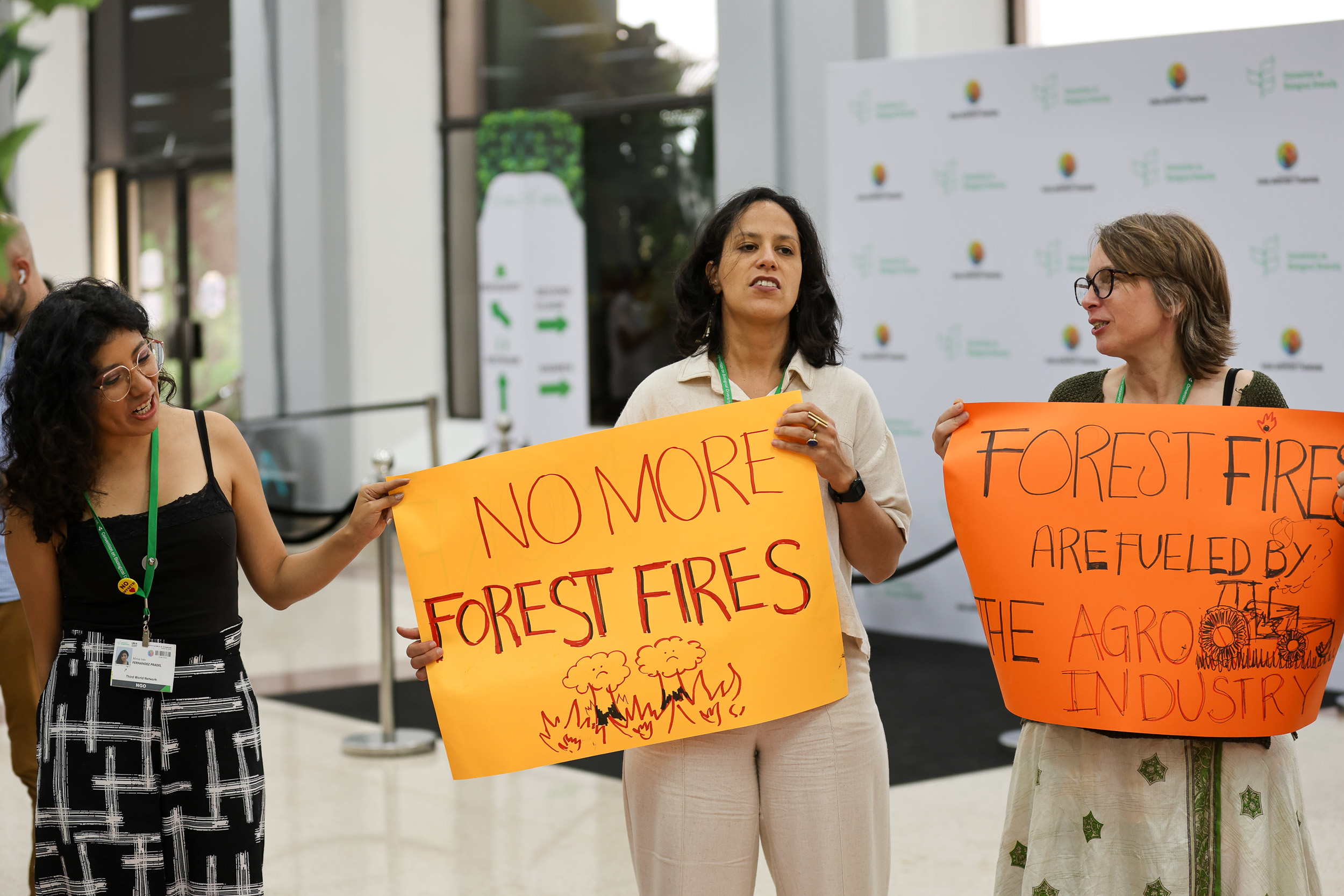

Legal proceedings against environmental defenders and government’s go-ahead for the controversial Amulsar gold mine expose widening gap between Armenia’s CBD COP17 commitments and the realities facing communities and biodiversity defenders
YEREVAN, Armenia, 14 October 2026 — Just days before Armenia hosts the UN Biodiversity Conference, serious concerns are mounting over the country’s preparations for COP17, as environmental defenders face renewed judicial harassment, civil society and community voices continue to be sidelined, and the government has moved ahead with the controversial Amulsar gold mine despite years of environmental and human rights concerns.
The Amulsar case also exposes a wider contradiction at the heart of the global biodiversity crisis: an extractive project that destroys biodiversity while relying on biodiversity offsets to claim that those impacts can be compensated.
Representatives of Armenian civil society and concerned citizens this week issued a statement condemning the launch of operations at the Amulsar gold mine. The Global Forest Coalition (GFC) stands with those environmental defenders and is calling on Armenia, the Convention on Biological Diversity (CBD) and governments attending COP17 to confront these contradictions and ensure that the global review of biodiversity action addresses the root causes of biodiversity destruction, rather than creating new mechanisms to compensate for or financially benefit from that destruction.
The 17th meeting of the Conference of the Parties to the Convention on Biological Diversity (CBD COP17) takes place in Yerevan from 19–30 October. Governments will review collective progress towards implementing the Kunming-Montreal Global Biodiversity Framework (KMGBF), while also conducting the mid-term review of the CBD Gender Plan of Action (2023–2030).
If this is the situation on the ground in the days before governments begin their deliberations, what hope can we have of meaningful progress at COP17?
Environmental defenders must be protected, not silenced
On 9 October, international human rights organisations expressed serious concern over renewed legal proceedings brought by Lydian Armenia, the mining company behind the Amulsar project, against women environmental human rights defenders Nazeli Vardanyan, a GFC board member, and Tehmine Yenoqyan.
The proceedings concern public statements and advocacy related to the Amulsar gold mine. International Federation for Human Rights (FIDH), the World Organisation Against Torture (OMCT) and the Civil Society Institute have warned that the cases bear characteristics of Strategic Lawsuits Against Public Participation (SLAPPs) and could have a chilling effect on environmental advocacy and public-interest debate.
Environmental defenders, lawyers, scientists and affected communities must be able to scrutinise projects affecting biodiversity, water and human rights without intimidation or retaliation, GFC said.
“The people defending biodiversity cannot be treated as obstacles to development. They are the people who must have the power and resources to protect territories and implement real solutions,” said Nazeli Vardanyan, environmental lawyer, GFC board member and founder and director of GFC member organisation Armenian Forests.
Amulsar: destroying biodiversity and then paying to offset it
On 10 October, the Armenian Government officially marked the launch of operations at the Amulsar gold mine, just days before Armenia hosts COP17. The project has faced years of opposition and concern from affected communities, environmental organisations and experts over its potential impacts on water, biodiversity and local livelihoods.
Yet Amulsar is also a textbook example of the false promise of biodiversity offsets.
The project’s environmental planning included a biodiversity offset programme intended to compensate for significant residual impacts of the mine. The European Bank for Reconstruction and Development (EBRD) explicitly earmarked financing for this offset programme, while Lydian itself described the proposed offset as a mechanism to compensate for impacts that could not otherwise be mitigated.
But independent analysis has questioned whether such an offset can compensate for the destruction of habitats and biodiversity at Amulsar, including by Bankwatch, which documented serious problems with the proposed offset. And in a professional opinion on the project’s biodiversity assessment, Karen Manvelyan, then Director of WWF Armenia, warned that open-pit mining would completely destroy natural habitats at Amulsar and that neither the establishment of Jermuk National Park nor restoration of degraded areas could recreate the specific biodiversity and complex ecological relationships that would suffer permanent and irreversible impacts.
These concerns are not new. In its 2022 research, Forest Cover 67, the Global Forest Coalition documented the experience of residents of Jermuk and their opposition to the Amulsar gold mine. The research found that the project threatens the area’s forests, freshwater resources, biodiversity and livelihoods, while mining-related changes risk worsening gender inequalities by damaging sectors such as tourism and food production that provide important livelihoods for women. It also documented the absence of meaningful consultation with affected communities. For Jermuk residents, the message was clear: “Our water is our gold.”
“Amulsar is a powerful example of the cycle driving the biodiversity crisis: destroy nature for short-term profits; greenwash the destruction to justify business as usual; increase debt through financing arrangements and conditionalities that can impose austerity while economic benefits flow disproportionately to the wealthy; and then allow powerful actors to lobby to keep the cycle going,” said Valentina Figuera Martínez, Gender Justice and Forests Campaign Coordinator at the Global Forest Coalition. “This is precisely the cycle that a meaningful global biodiversity review must confront. We cannot claim progress while continuing to reward the same economic model that is driving biodiversity loss.”
The finance gap cannot become a licence for destruction
The Amulsar case also demonstrates why the question of biodiversity finance cannot be separated from global economic inequality. Countries in the Global South face enormous pressure to generate revenues and attract investment, while the Global North continues to fall short of its responsibilities to provide adequate public finance for biodiversity and climate action. GFC is calling on Global North countries to fulfil their obligations under Article 20 of the Convention on Biological Diversity, including commitments on financial resources and technology transfer.
Without adequate, accessible and equitable public finance, countries can be left facing a destructive choice: protect biodiversity without the resources to do so, or turn to extractive industries and other activities that promise short-term revenues while creating long-term social and ecological costs. The answer cannot be to finance destruction and then create markets to compensate for it.
COP17 must confront the root causes
The global review of the Kunming-Montreal Global Biodiversity Framework will be a failure if it measures progress without confronting the systems driving biodiversity loss. Indigenous Peoples, local communities, women, youth, small-scale farmers, Afrodescendant peoples and other rights-holders must have meaningful power over decisions affecting their territories and resources. Women and other rights-holders must not simply be treated as beneficiaries or consulted after decisions have already been made.
Power and agency must be returned to the people who are already protecting biodiversity and who are capable of implementing real solutions. Governments and corporations must also be held accountable for actions that destroy biodiversity, undermine rights and weaken communities’ ability to protect their territories.
“COP17 cannot be about finding new ways to make biodiversity destruction financially acceptable. It must be about changing the systems that drive that destruction, ensuring that those responsible are held accountable and putting resources and decision-making power in the hands of the people who are already protecting biodiversity,” said Martínez. “The warning signs are already visible in Armenia. COP17 must listen.”
The credibility of COP17 will ultimately be measured not by the number of new financial mechanisms or biodiversity commitments announced, but by whether governments are prepared to confront the root causes of biodiversity loss and support the people who are protecting biodiversity on the ground.
For media inquiries:
ismail.wolff@globalforestcoalition.org
For more information on GFC and its role at CBD COP17, please visit our website.