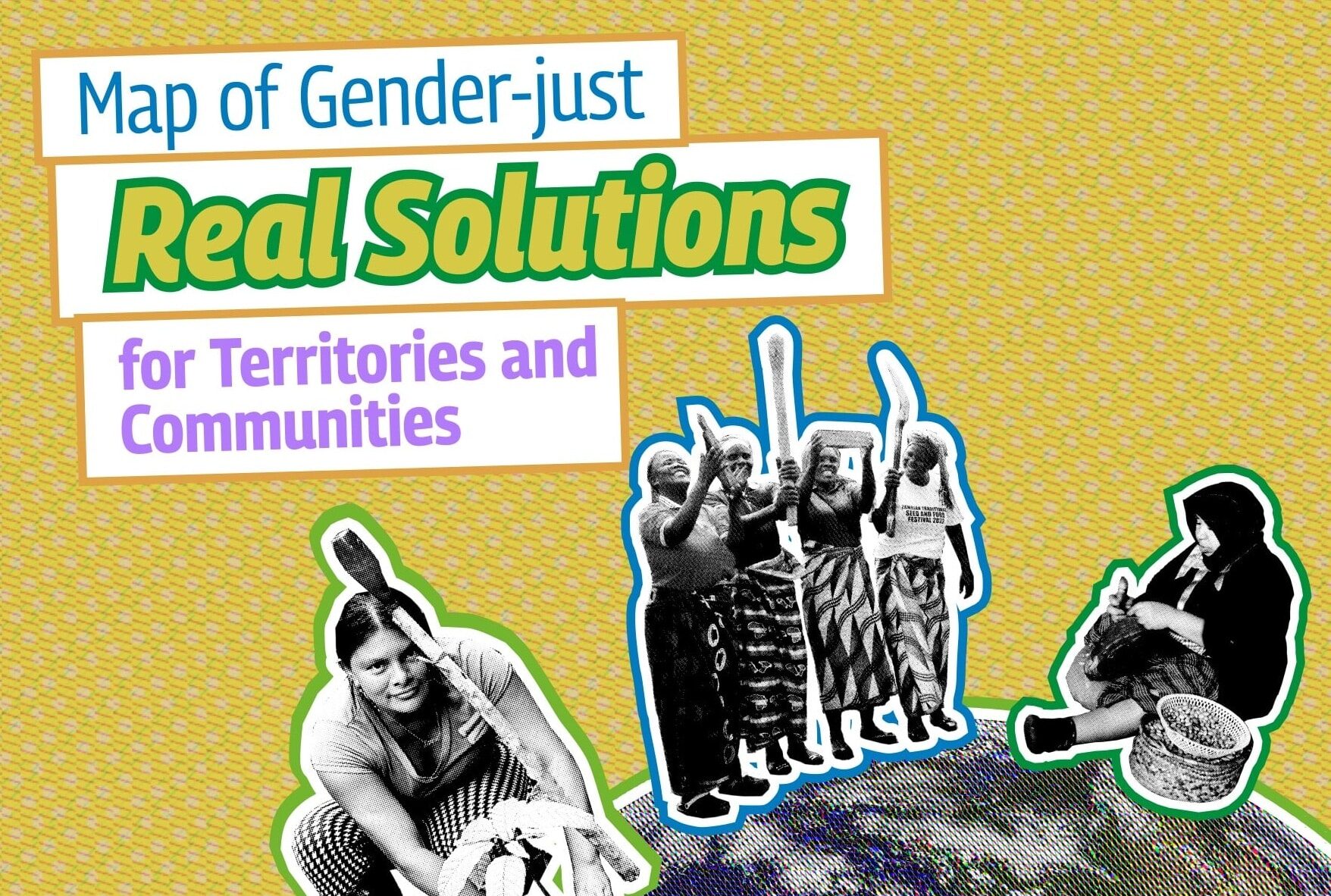
Communities around the world are already building the solutions we need to confront the intersecting social, ecological and climate crises we face. At COP31 in Antalya, Turkey, the Global Forest Coalition is launching a new tool to make these solutions visible: the Map of Gender-Just Real Solutions for Territories and Communities.
At a time when governments and corporations continue to promote false solutions such as carbon and biodiversity markets as answers to climate breakdown and biodiversity collapse, and UN processes become more and more captured by lobbyists, we need to look elsewhere for inspiration and concrete responses to overcome the crises.
The real solutions are already here
Across the Global South, Indigenous Peoples, local communities, women, youth, gender diverse people and grassroots organisations are protecting territories, restoring ecosystems, sustaining food systems, defending biodiversity and building more just and resilient economies. These initiatives are rooted in particular places, cosmovisions, cultures and relationships with nature. They are not commodities to be traded or generic models waiting to be scaled up.
The Map of Gender-Just Real Solutions brings some of these initiatives together in one place, helping to make visible the people, practices, values, rights and conditions that can underpin transformative change.
From the ground up
The map begins with six examples of gender-just, community-led real solutions.
They include the Nainu ancestral farming and agroforestry system of the Gunadule People in the Gunayala territory, in Panama, where traditional knowledge, food sovereignty, biodiversity protection and the active role of women and youth are central. In Zambia, the map features the Kamukolwe Multipurpose Cooperative Society, where women farmers are using agroecology, traditional seed saving and community-based alternatives while resisting the impacts of copper mining, as well as the Kapyanga Women’s Association, which combines agroecology, Indigenous seeds, forest restoration and local economic empowerment.

In Morocco, the map highlights the role of Amazigh Indigenous women in protecting argan forests, maintaining traditional ecological knowledge and strengthening women-led cooperatives and livelihoods. In Bangladesh, it documents Indigenous-led public interest litigation to protect the Madhupur Sal Forest, demonstrating how legal action, collective mobilisation and recognition of customary rights can contribute to forest protection.
And in the Bolivian Amazon, the map explores territories free from extractivism, where Indigenous Peoples, rural communities and agroecological organisations are working together to protect forests, rivers and livelihoods from gold mining.
These are only the beginning. The map is designed to grow.
Gender justice is at the heart of the map
A gender-just approach is essential because the defence and care of territories and ecosystems is deeply connected to gender relations and patriarchal structures.
Women in all their diversity hold critical traditional knowledge of ecosystems, food systems, seeds and natural resources, while carrying a disproportionate share of unpaid care and domestic work. Yet they remain systematically excluded from decision-making, land ownership, access to resources and political power. Gender-diverse people, youth and people with disability are equally invisibilized from power spaces and excluded in policy design, while confronting multiple forms of violence in territories.
The initiatives featured in the map demonstrate that gender justice is not simply about ensuring that women are represented. It is about who has power, who makes decisions, who controls land and resources, whose knowledge is valued, and who benefits from the protection of territories and ecosystems.
That is why gender justice and intersectionality are core criteria for inclusion in the map. Initiatives must demonstrate meaningful leadership and participation by women, youth, gender-diverse people and/or people with disabilities, alongside a human-rights-based and non-market approach.
What makes a real solution possible?
The map does not simply ask “What is the solution?” It also asks: What makes it possible? And what stands in its way?
Communities do not need another externally imposed blueprint for how to protect their territories. Their solutions are specific to their histories, cultures, ecosystems and forms of governance. Instead of trying to scale up a particular practice everywhere, we need to understand and strengthen the conditions that allow diverse real solutions to flourish.
Across the initial cases, these conditions include secure land and territorial rights, autonomous and community-led governance, traditional and local knowledge, collective organising, women’s leadership, supportive legal frameworks, access to public financing, and protection from extractivism.
At the same time, communities face systemic barriers including land grabbing, extractive industries, destructive infrastructure, corporate influence over policy, insecure land rights, inadequate financing, patriarchal structures and the continued marginalisation of Indigenous and local knowledge. Making these conditions and barriers visible is crucial for changing policy.
A methodology built collectively
The map itself has been built through a participatory process. Global Forest Coalition members and allies worked together to develop its political framing, inclusion and exclusion criteria and data collection approach. Through collective discussions, participants explored what distinguishes a real solution from a false one, how gender justice should be understood, and which social, political, ecological, economic and cultural conditions allow community-led initiatives to thrive. This collective process matters. A map about communities should not be designed for communities without their participation and control.
The methodology is therefore based on principles including collective ownership, community consent and control, shared power and responsibility, and non-commercial use. It is also deliberately evolving. As more communities and organisations contribute, the methodology will continue to be reviewed, challenged and strengthened.
The initial process brought together GFC members and allies working across the Global South, and the project now opens the door for many more communities and organisations to contribute.
From Antalya and beyond
We are launching the Map of Gender-Just Real Solutions at COP31 in Antalya, where we will also hold a workshop during the People’s Summit to introduce the map and its methodology to allies, members and partners. The workshop will be an opportunity to explore the initial cases, discuss how the map can support collective struggles against false solutions, and gather feedback to help shape its future development. This is particularly important because the map is intended to remain participatory and open to continued learning.
This launch is therefore not an endpoint. It is a beginning.
We invite Indigenous Peoples’ Organisations, community groups, women’s organisations, grassroots movements and civil society organisations to explore the map, share it with others and help us build it further.
If you know of a gender-just, community-led initiative that should be represented, we want to hear from you. You can contact us at contact@realsolutionsmap.org to find out more about the criteria and methodology and how to suggest an initiative for inclusion.
Together, we can make visible the solutions that are already protecting forests, biodiversity, territories and communities, and build the political power needed to remove the barriers that stand in their way.
Explore the Gender-Just Real Solutions Map at https://realsolutionsmap.org/

