

As we mark the International Day of Forests this Saturday, March 21, we come together to reiterate our united resolve to stand up to the complex and multitude threats that continue to face our forests and the rights of those who depend on and protect them. In particular, we continue to fight back against the false and market-based solutions to the climate and biodiversity crises being peddled through the corridors of power at the United Nations and other global policy spaces.
Despite these challenges, we remain energised and humbled by the work of all our members, and of forest and local communities, Indigenous Peoples, women, gender diverse people, youth and all those who are already implementing the real solutions that protect our forests and ecosystems, and uphold and defend the rights of those who depend on and safeguard them.
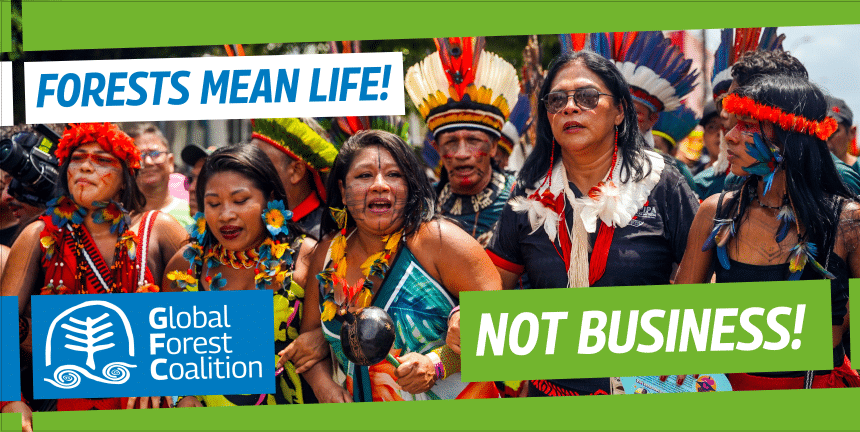

This challenge of pushing back against false solutions in key policy spaces is clearly reflected in this year’s framing of the International Day of Forests by the United Nations Food and Agriculture Organisation (UNFAO). Under the theme “Forests and Economies” and the tagline “Forests mean business,” the emphasis on increased wood harvesting, expansion of the bioeconomy, and substituting forest-based materials for fossil fuels advances a dangerous narrative that reduces forests to commodities and risks accelerating their degradation. This isn’t the first time we have had to call out the FAO for its pro-market approach.
So we say clearly today to the FAO: “Forests mean life, not business!”
The FAO’s framing values forests according to “economic interests”, contradicting the UN Convention on Biological Diversity’s (CBD) precautionary principle and undermining the multiple, irreplaceable, life-supporting functions that forests provide: climate regulation, biodiversity conservation, water cycles, and the sustenance of forest-dependent and Indigenous Peoples. At a time when forests are already under immense pressure, promoting increased extraction, whether for biomass energy, industrial roundwood, or disposable products, only deepens ecological and social harm.
In response, the Biomass Action Network (BAN) has raised serious concerns about this direction. BAN has formally written to the FAO, without response, and is mobilising collective actions to challenge these narratives and approaches, and amplify a shared call: forests are not fuel, and they are not a substitute for overconsumption. Please help BAN pressure the UNFAO to drop its pro-biomass messaging by making some “noise” on social media – they’ve put together a social media toolkit with everything you need.
So-called solutions such as large-scale bioenergy, material substitution, and other market-based approaches are not real solutions. They perpetuate gender injustices, overconsumption, obscure emissions through flawed carbon accounting, and allow business-as-usual to continue under a greenwashed narrative. A truly just and sustainable future requires systemic changes, reducing material and energy consumption, transitioning to genuinely renewable energy sources, and supporting community-led, rights-based approaches that respect ecological limits.
The Global Forest Coalition firmly rejects these false solutions. We stand for transformative change, rooted in human rights, gender justice, and the leadership of Indigenous Peoples, local communities, women and youth, recognising forests as living ecosystems, not carbon stocks or commodities.
From False Solutions to Transformative Change
On this day, we also honour and celebrate the unwavering commitment of our more than 130 member groups across over 70 countries. Each day, you defend forests and ecosystems against extractive industries, industrial livestock expansion, monoculture plantations, and other destructive drivers. At the same time, you uphold and advance the rights of forest-dependent peoples, Indigenous Peoples, women in all their diversities, and youth, whose knowledge, stewardship, and leadership have sustained forests for millennia.
We are proud to mark this occasion with the launch of Forest Cover: 70 From False Solutions to Transformative Change, the latest edition of our flagship publication, now available in English, Spanish, and French.
Download Forest Cover 70
From False Solutions to Transformative Change: How Communities are Overcoming Systemic Barriers to Climate Action
English | Español | Français
Forest Cover 70 brings together powerful case studies and firsthand testimonies from GFC members and allies in Bangladesh, Bolivia, Chile, Morocco, Panama, and Zambia. It exposes how extractivism and corporate-driven “green” solutions act as systemic barriers to gender-just, community-led real solutions, reinforcing structural inequalities while threatening the rights, lands, and lives of Indigenous Peoples, local communities, women, and youth.
At the same time, the publication highlights how communities are resisting and overcoming these barriers. From women-led agroecological initiatives and seed-saving practices to Indigenous governance systems that reject carbon markets and commodification, these stories demonstrate that real solutions already exist and are being implemented on the ground. As highlighted by GFC Climate Justice and Forests Campaign Co-coordinators Jana Uemura and Oli Munnion, meaningful climate and environmental action requires transformative change across economic, social, and political systems. Incremental adjustments and market-based mechanisms will not address the root causes of the crises we face.
Across the case studies, a clear message emerges: climate solutions that rely on extractivism, carbon markets, monoculture plantations, or so-called “critical minerals” extraction continue to externalise harm onto communities, particularly in the Global South, while entrenching inequality and ecological destruction. In contrast, community-led approaches grounded in human rights, gender justice, and collective governance offer pathways toward truly sustainable and equitable futures. We warmly invite you to read Forest Cover 70 and share it widely within your networks. Amplifying these voices is essential to shifting global narratives and strengthening collective action.
As we mark this International Day of Forests, let us reaffirm our shared commitment to protecting forests and advancing real solutions, solutions that respect the rights of Indigenous Peoples and forest-dependent communities, uphold gender justice, and challenge the systems driving deforestation and climate breakdown.


