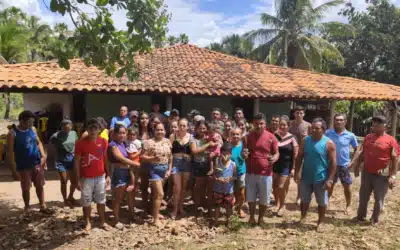

GFC members and allies are helping to build a new gender-just map of community-led solutions for forests, people and the planet.
What does a real solution to the climate and biodiversity crises look like?
It might be an agroecological farming system rooted in traditional knowledge. It might be a community defending its territory from extractive industries. It might be women organising to protect forests, strengthen food sovereignty or build more equitable forms of community governance.
And it is not just about what communities are doing. It is also about what makes these solutions possible, and just as importantly, what stands in their way.
These questions are at the heart of a new Gender-Just Real Solutions Map for Forests and Communities being developed by the Global Forest Coalition (GFC), with support from Bread for the World (Brot für die Welt) and the Rosa Luxemburg Foundation (RLF). Over three online sessions held in July and August, GFC members and allies from across the Global South have been working together to shape the ideas, criteria and methodology that will underpin the map.
The process began in July with a discussion about what a false solution is, and what makes a solution real. Participants shared examples from their own territories and explored how community-led alternatives differ from false solutions that can reproduce environmental destruction, inequality and corporate control. Importantly, the group agreed that the map should focus on concrete, localised practices rooted in particular territories, rather than treating “solutions” as generic or easily scalable commodities.
The second session put gender justice at the centre. Rather than treating gender as simply a question of whether women are represented or participate, participants explored who does the work, including unpaid care and domestic work; who makes decisions; who controls land, resources and income; and what would make an initiative genuinely gender-just. The discussion also considered how the map itself can challenge the underlying colonial and patriarchal systems that shape relationships between people, territories and nature.

Members of a community forest user group are managing their community forest in Nawalparasi district. Nawalparsi FECOFUN
As Jaqueline Santos of FASE, a GFC member group in Brazil, explained, women in Pará play a leading role in agriculture and in protecting their territories. She also highlighted the importance of women’s groups and support networks in rural communities, where women facing violence can struggle to access formal systems of support.
“Their perspective, their understanding of what constitutes a territory, and their knowledge of what must be preserved and protected are given much greater prominence and attention by women,” said Santos. “In Brazil, we have a situation where it’s very difficult to report violence in the city. In rural areas, it’s very difficult to file a report (…) There’s an entire system that doesn’t support women who have been victims of violence. The state is designed for men. We work intensively on the issue of violence with support groups. There must be women’s groups in these communities, because there’s no space for women in groups where men participate,” she said.
The third session then turned to a question that is crucial for understanding how real solutions can flourish: what conditions do they require?
Participants discussed ecological, social, economic, political and cultural conditions, including community organising, legal frameworks, self-determination, autonomous governance, community-led financing and gender-responsive practices. They also identified barriers ranging from extractive projects and land grabbing to patriarchal policies, colonial legal frameworks, bureaucracy, lack of funding and the criminalisation of environmental defenders.
Ariella Kabunga of the Integrated Program for the Development of the Pygmy People in Kivu (PIDP) stressed that gender justice requires more than gender-just laws on paper. Women must be able to participate meaningfully in decision-making, influence decisions and take on positions of responsibility.
“We need political and legal frameworks to ensure equal rights for women. But it is not enough to have gender-just laws and policies. It is also necessary to ensure the dissemination, application, and monitoring implementation at the national, local, and community levels. Community organizations and structures must integrate gender into their policies, programs, budgets and decision-making mechanisms,” Kabunga said. “Another fundamental condition is the effective participation of women in decision-making processes. It is not enough to invite women to a meeting. They must have the opportunity to express themselves, influence decisions, and hold positions of responsibility.”
These discussions are now helping to build the map itself. The first set of inclusion and exclusion criteria is being shared with participants for validation and further input, while GFC and the Critical Geography Collective (CGC) are also working with participants to develop a protocol for protecting information and safeguarding data.
The emerging methodology will ensure that the map is not simply a collection of points on a screen. Each entry will tell a story: What is the initiative? Why is it a real solution? Who is involved? Where and when is it happening? And how has it been made possible? Users will be able to explore different kinds of initiatives, from agroecology and forest protection to traditional knowledge, sustainable livelihoods and territories free from extractivism, as well as the conditions that have enabled them to flourish.
The map will therefore be a space to see and learn from each other’s experiences, forms of resistance and social action, rather than imposing a single model of what a solution should look like. As the project’s methodology notes, real solutions are diverse, territorial and shaped by the communities themselves. The map is intended to grow from that diversity and remain open to continued revision and learning.
Ultimately, the goal is to make visible what too often remains invisible: the people, practices, rights and conditions that already offer pathways towards protecting forests, biodiversity and communities, without relying on markets to put a price on nature.
The Gender-Just Real Solutions Map for Forests and Communities is expected to launch in November 2026, with the database continuing to grow beyond the initial launch.
Stay tuned — the map is taking shape.
A map built collectively
The Gender-Just Real Solutions Map is being developed collaboratively with the Critical Geography Collective (CGC) and GFC members and allies working with communities and movements across the Global South. Organisations participating in the design of the map, its criteria and its initial entries include:
- Bangladesh Environmental Lawyers Association (BELA) — Bangladesh
- Federation of Social and Educational Assistance Organisations (FASE) — Brazil
- Fundación de Expresión Intercultural, Educativa y Ambiental (FUNDAEXPRESIÓN) — Colombia
- Colectivo VientoSur — Chile
- Programme Intégré pour le Développement du Peuple Pygmée au Kivu (PIDP) — Democratic Republic of Congo
- Instituto para el Futuro Común Amerindio (IFCA) — Honduras
- Federation of Community Forestry Users Nepal (FECOFUN) — Nepal
- National Forum for Advocacy Nepal (NAFAN) — Nepal
- Centro de Desarrollo Ambiental y Humano (CENDAH) — Panama
- Zambia Social Forum (ZAMSOF) — Zambia
- Global Tapestry of Alternatives (GTA) — global network
- Latin American and Caribbean Platform for Climate Justice (PLACJC) — regional network
Have a real solution to share?
We are also inviting organisations and community groups to suggest initiatives or projects that they think meet the map’s criteria. If you know of a community-led initiative that could belong on the map, please contact Valentina Figuera Martínez, GFC’s Gender Justice and Forests Campaign Coordinator, who is leading the project, at valentinafmartinez@globalforestcoalition.org.