Derail negotiations on market mechanisms: false solutions will not bring equity and climate justice
13 June 2019
by Souparna Lahiri, Global Forest Coalition, India
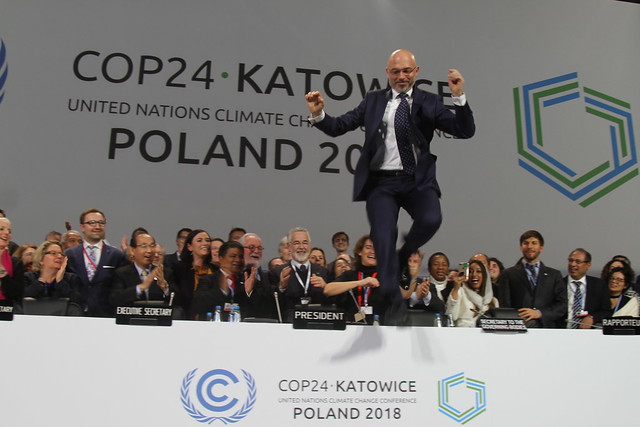
The outcome of COP24 in Katowice last December failed on many counts, despite the “victory leap“ of the Polish Secretary of State for Energy (COP24’s president-designate). But what made front page news was the failure of governments to agree to a text on Article 6, which deals with market-based mechanisms in the Paris Agreement.
The "victory leap" at the end of COP24's failed negotiations. UNclimatechange/Flickr
We know why it failed, and what the primary barriers to achieving consensus were:
Double counting: Basically cheating by accounting for emissions reductions twice, both where carbon credits are created in originating countries and in the country that buys the credits;
The transition of the Clean Development Mechanism (CDM) from the Kyoto Protocol to the Sustainable Development Mechanism (SDM) of the Paris Agreement: Countries benefiting from finance under the old CDM want to see it continued, but others have been flooded by what they see as “fraudulent” credits, and do not want to continue the mechanism post 2020, citing lack of environmental integrity;
Avoidance of emissions: This will potentially include “Reducing emissions from deforestation and forest degradation and the role of conservation, sustainable management of forests and enhancement of forest carbon stocks in developing countries (REDD+)” and forestry offsets, both highly controversial;
Achieving overall mitigation of global emissions through market mechanisms: Proposed mainly by the Small Island Developing States. It would imply that either the host country or the destination country voluntarily accepts the automatic or discounted cancellation of offset credits in future, to ensure that market mechanisms actually drive down global emissions physically and not just on paper.
We also know how, between last year’s intersessional in Bonn and COP24 in Katowice, the Article 6 texts were systematically purged of rights language, violating the spirit and preamble of the Paris Agreement, and exposing the fact that “the market” has no respect for human rights.
It is also a fact that the negotiators did not show any urgency in developing an architecture around Article 6.8, which is the pathway to non-market mechanisms embedded in Article 6, again showing the complete dominance of the market in the negotiations.
As the struggles and movements for system change, degrowth and real climate solutions take shape, the world of Article 6 is a counter strategy adopted by corporations and corporate-controlled governments to reap profits from the climate crisis. Amongst other schemes, it will involve: peddling removals and emissions cuts through offsets, thus providing a life line to the fossil fuel and aviation industries; creating loopholes for pushing through dangerous techno-fixes such as geoengineering and Bioenergy with Carbon Capture and Storage (BECCS); and mechanisms such as the CDM which trade in carbon credits that are obtained from dubious and often fraudulent projects that violate the rights of women, Indigenous Peoples and local communities.
Offsetting, emissions trading and techno-fixes are all false solutions that have been denounced by Indigenous Peoples and local communities on the front lines, the climate justice groups, and by gender and women’s rights advocates. But the negotiations around these false solutions often happen in isolation, dominated by corporations and their consultants. The technicalities and jargon are also reasons for the absence and lack of engagement of civil society in the negotiating rooms. This gap needs to be bridged.
These cocooned negotiations peddling false solutions and profit-making market mechanisms need to be challenged, both inside and outside the confines of the UN climate summits. Article 6 negotiators have to be exposed to the real world, and the struggles and voices of the communities, women, and future generations that are growing up in an increasingly uninhabitable world.
The failure of the Article 6 negotiations in Katowice has provided us with an opportunity to re-think, strengthen our resolve and strategise on the challenges ahead. Market mechanisms are the antithesis of real climate solutions, and should play no role in helping to achieve the Paris Agreement’s goal of keeping this planet’s temperature increase below 2 degrees. There can be no climate justice or equity in climate policies unless we derail the negotiations on Article 6, whilst also making sure that the “non-market” based alternatives in Article 6.8 are given the prominence they need.
Photo credit above: Stephen Melkisethian/Flickr