
Global Forest Coalition
The Global Forest Coalition is an international coalition of NGOs and Indigenous Peoples’ Organizations that advocates for the conservation and restoration of forest ecosystems, through defending and promoting respect for the rights, territories, traditional knowledge and sustainable livelihoods of the Indigenous Peoples, local communities and women that co-exist with them.
Learn more
Our campaigns
Donate
Latest news
No Results Found
The page you requested could not be found. Try refining your search, or use the navigation above to locate the post.
Jet fuel crisis is the ‘new normal’: 95+ groups launch manifesto to stop aviation growth
95+ groups across 25 countries have responded to the jet fuel crisis with a manifesto demanding ten measures are implemented to reduce air traffic. The manifesto highlights aviation’s impacts, from climate heating to militarisation. Stay Grounded described the jet...
Event in Santa Marta: Unmasking False Solutions: Weaving Just Transitions
On the occasion of the 1st Conference for the Transition Beyond Fossil Fuels and the People’s Summit for a Fossil-Free Future, taking place in Santa Marta, Colombia, in April 2026, we invite you to the event Unmasking False Solutions: Weaving Just Transitions, on...
Demystifying land-based geoengineering: Why these “solutions” are incompatible with climate justice
The Global Forest Coalition and HOME Alliance are pleased to invite you to join a webinar on land-based geoengineering, that will take place on April 29th across two time zones. First webinar with a focus on Asia, Africa & Europe at 12-1:30pm UTC Second webinar...
Our Campaigns
Climate Justice & Forests
GFC opposes corporate influence over climate and forest policy and exposes false solutions that harm ecosystems and communities, especially women, youth, and Indigenous Peoples. We defend forests, support community stewardship, and promote rights-based, gender-just approaches to climate mitigation for a fairer, more resilient world.
Gender Justice & Forests
The campaign promotes decolonial, feminist approaches to forest conservation that centre the rights, knowledge, and leadership of women in all their diversity. By supporting inclusive, community-led forest governance and dismantling intersecting systems of oppression, we work to protect forests while reducing gender inequalities and strengthening women’s access to decision-making and resources.
Unsustainable Livestock
GFC’s Unsustainable Livestock Campaign works to challenge factory farming, end harmful incentives, and promote agroecology and plant-rich diets that protect forests, defend rights, and support gender justice.
ETI
Forests and communities are under threat from mining, fossil fuel extraction, mass tourism, and mega-infrastructure projects. GFC’s Extractive Industries, Tourism and Infrastructure Campaign fights to defend rights, protect livelihoods, and stop destructive industries in their tracks.
Climate Justice & Forests
GFC opposes corporate influence over climate and forest policy and exposes false solutions that harm ecosystems and communities, especially women, youth, and Indigenous Peoples. We defend forests, support community stewardship, and promote rights-based, gender-just approaches to climate mitigation for a fairer, more resilient world.
Gender Justice & Forests
The campaign promotes decolonial, feminist approaches to forest conservation that centre the rights, knowledge, and leadership of women in all their diversity. By supporting inclusive, community-led forest governance and dismantling intersecting systems of oppression, we work to protect forests while reducing gender inequalities and strengthening women’s access to decision-making and resources.
Unsustainable Livestock
GFC’s Unsustainable Livestock Campaign works to challenge factory farming, end harmful incentives, and promote agroecology and plant-rich diets that protect forests, defend rights, and support gender justice.
ETI
Forests and communities are under threat from mining, fossil fuel extraction, mass tourism, and mega-infrastructure projects. GFC’s Extractive Industries, Tourism and Infrastructure Campaign fights to defend rights, protect livelihoods, and stop destructive industries in their tracks.
Insights

Statement by the Global Forest Coalition (GFC) Against the US’s Illegal Intervention in Venezuela
In response to the United States’ military...

HOME Alliance Slams COP30 Captured by Carbon Markets and Illusionary Fixes like Geoengineering
Belém, Brazil - In a betrayal of Indigenous...
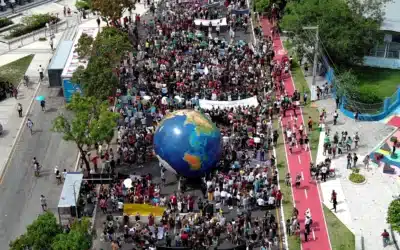
The Tables Turn Against the TFFF
From Rio de Janeiro-2024 to Belém-2025 By Mary...
Protecting forests, empowering communities, fighting for climate justice
Climate Justice & Forests


Gender Justice & Forests

Your Support Amplifies Community Voices
Help us protect forests, empower communities, and fight for climate justice


